Introduction
The global technology landscape is undergoing its most radical transformation since the dawn of the internet. While the early 2020s were characterized by the exploratory buzz of Generative AI—focused largely on content creation, basic image generation, and chat interfaces—the industry in May 2026 has fundamentally shifted toward structural autonomy.
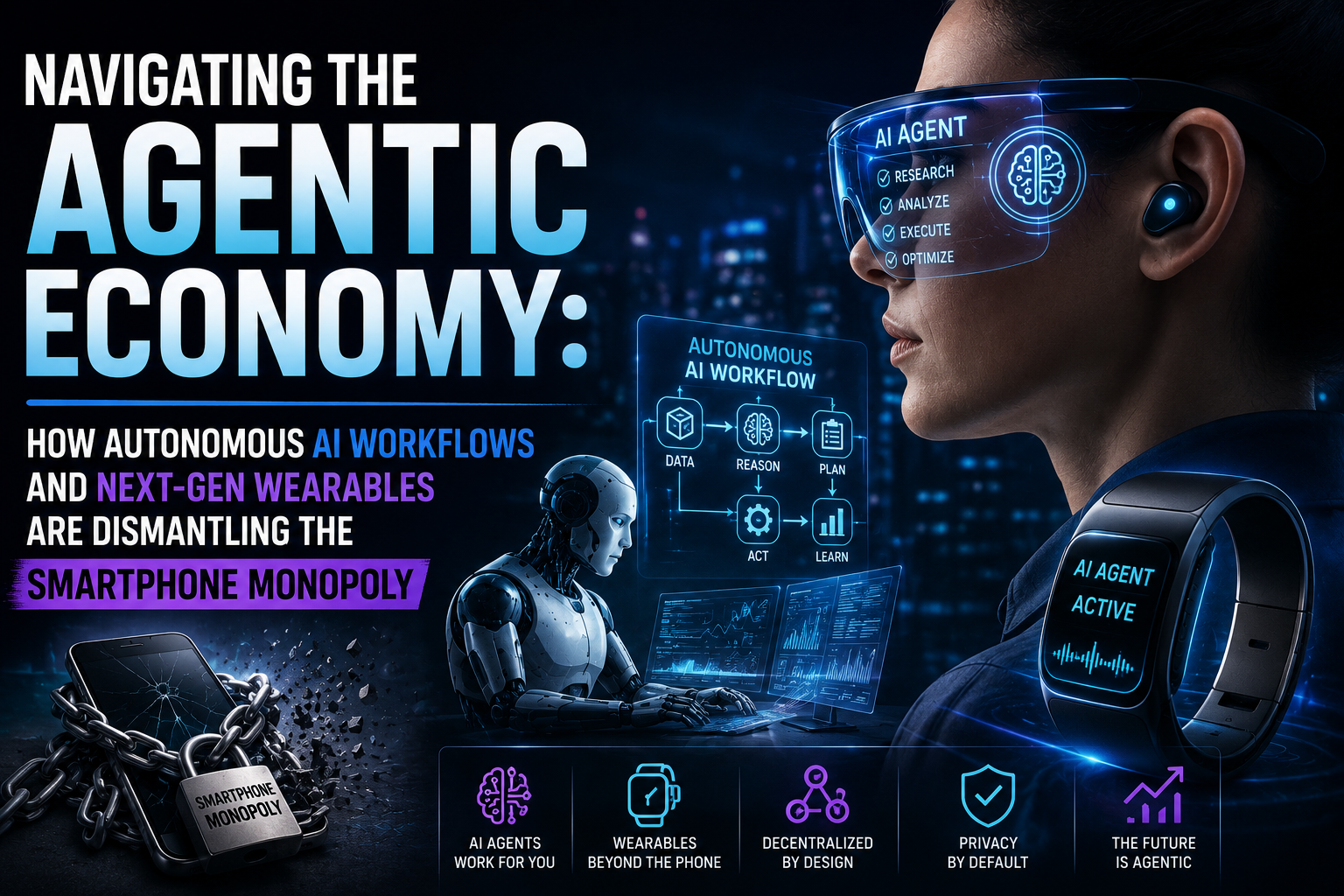
We are officially witnessing the birth of the Agentic Economy. Driven by enterprise demands for hyper-efficiency, technological frameworks are transitioning toward autonomous AI agents that operate 24/7 without human intervention. Concurrently, this rapid evolution is dismantling traditional hardware form factors, sparking a massive shift away from app-based mobile ecosystems toward AI-native devices. This comprehensive technological breakdown explores the structural rise of agentic workflows, the next generation of ambient hardware, and the profound economic disruptions ahead.
The Rise of Agentic AI: Moving From Prompts to Autonomous Execution
The primary driver of the tech economy today is the shifting capability of enterprise AI systems. Traditional large language models (LLMs) required continuous human prompt engineering to deliver static outputs. Agentic AI, conversely, introduces advanced contextual reasoning, autonomous decision-making, and execution capabilities.
Instead of merely writing an automated financial report, an enterprise AI agent can autonomously connect to corporate APIs, analyze real-time market data, execute asset rebalancing, and patch security vulnerabilities without requiring human oversight.
The Birth of AI-Only Organizations
As organizations rapidly integrate multi-modal AI agent workflows into their core infrastructure, the corporate world is reaching a critical tipping point. Industry experts project the imminent rise of AI-Native and AI-Only organizations—companies designed entirely from the ground up to be operated, maintained, and optimized by interconnected neural networks. This always-on corporate infrastructure promises unmatched operational productivity, fundamentally transforming global business strategies.
Hardware Revolution: The Shift to Wearable, Ambient Smart Devices
As AI model competition remains tightly tethered to cloud computing and data center infrastructure, consumer interaction models must evolve. The traditional app-dependent smartphone ecosystem is facing an existential crisis. The industry is aggressively pivoting toward wearable smart devices optimized to run lightweight, low-latency AI-native operating systems.
The Death of the App Ecosystem
Instead of unlocking a phone, opening a specific travel application, searching for dates, and executing a payment, the ambient wearables of May 2026 utilize multimodal AI to bypass apps entirely. Users can seamlessly interact with their environment via screen-free voice modules or advanced augmented reality (AR) smart glasses.
These connected smart devices act as a continuous nexus of personal data exchange, synthesizing information across public transit, corporate tasks, and digital healthcare networks. By delivering highly personalized service recommendations at the precise millisecond they are required, ambient hardware is creating an information-rich lifestyle that fundamentally alters human-computer interaction.
Enterprise Challenges: Security, Energy, and Trust in an Autonomous World
While the economic potential of the Agentic Economy is nearly limitless, its rapid deployment presents historic challenges for enterprise security and global infrastructure:
-
The AI Energy Crisis: The computational load required to sustain millions of autonomous agents operating simultaneously 24/7 has put a severe strain on traditional power grids. This has sparked a massive corporate rush into green computing architectures, decentralized energy sourcing, and neuromorphic chip designs to maximize hardware efficiency.
-
Autonomous Privacy & Trust: Implementing complex, self-contained workflows means that managing user consent and data privacy has become infinitely more complicated. Software engineers are currently prioritizing “Disinformation Security” and cryptographic validation frameworks to ensure that autonomous agents cannot be manipulated by adversarial prompt-injection attacks.
Conclusion
The transition toward an agentic, AI-driven macroeconomic model is no longer a future projection—it is the reality of May 2026. Businesses that fail to adapt their programmatic infrastructure to accommodate AI agents and ambient consumer hardware risk total obsolescence in an always-on global market.